
Themed tour
Footsteps of St Paul in 12 days, with Nicaea and the seven communities
Twelve days through biblical Turkey: Constantinople, the council of Nicaea, the seven communities of Revelation, Miletus and Perge, Pisidian Antioch, Iconium and the rock-cut churches of Cappadocia.
Private, tailor-made The vehicle and the guide are for your passengers only, and you choose the starting day.
Key facts
- Duration 12 days / 11 nights
- Route Istanbul → Cappadocia 18 destinations
- Quotation Quotation within 72 business hours
- Recommended months March–May, September–November
- Departure type Private, tailor-made
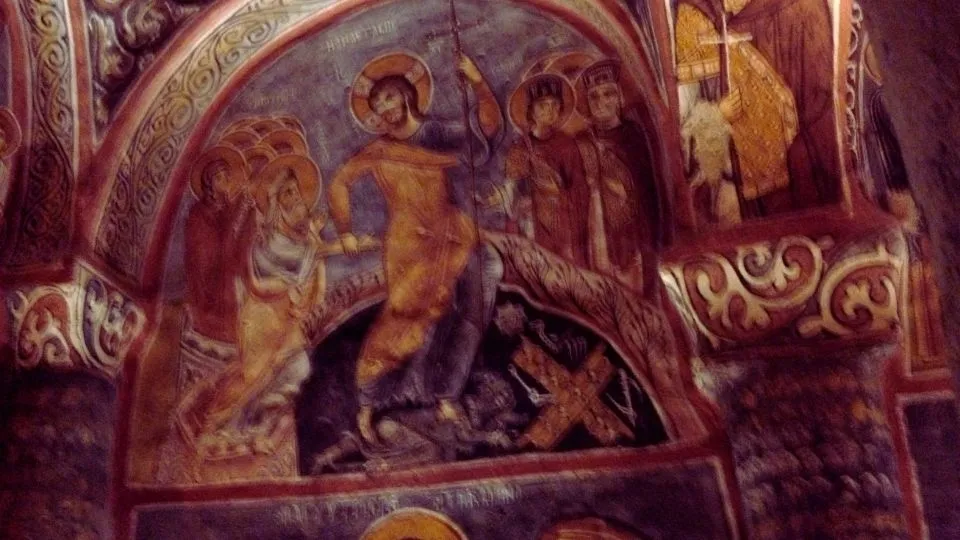
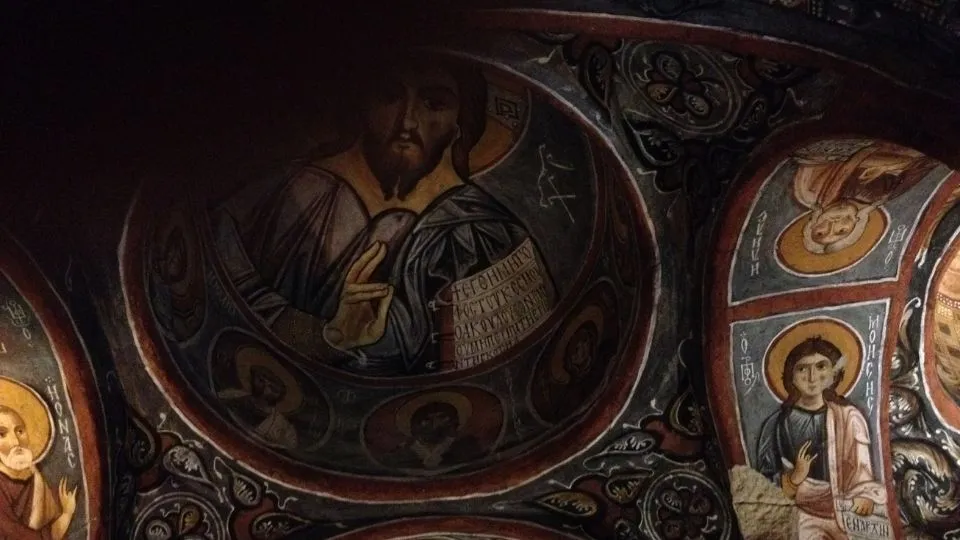
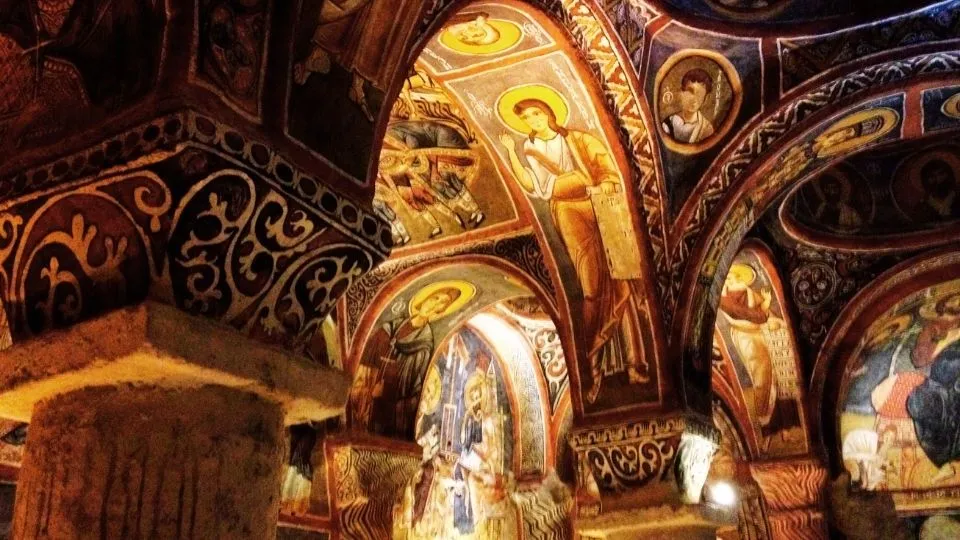
Frescoes with biblical scenes in a rock-cut church of Cappadocia, the last stage of the route.
Overview
It runs by private vehicle with driver and a licensed Spanish- or English-speaking guide with specific preparation in the Christian heritage of Anatolia, with the entrance fees for all the sites included, five dinners outside Istanbul, the Cappadocia – Istanbul domestic flight and mineral water in the vehicle.
The start date is the agency’s to choose. Quoted to order, in net rates.
Route: IstanbulIznik (Nicaea)BursaPergamonİzmirThyatira (Akhisar)SardisPhiladelphia (Alaşehir)LaodiceaPamukkaleEphesusMiletusKuşadasıPergeAntalyaAntioch of PisidiaKonyaCappadocia
- Physical level: Moderate
- Languages of the guided visits: Spanish, English
Highlights
- All seven churches of Revelation: Ephesus, Smyrna, Pergamon, Thyatira, Sardis, Philadelphia and Laodicea, with the entrance fees included.
- Nicaea, seat of the First and the Seventh Council, with its Roman walls and the submerged basilica of Lake Ascanius.
- St Paul’s Anatolian stages: Miletus, Perge, Attalia, Pisidian Antioch with the basilica over the synagogue of his first sermon, and Iconium.
- St Saviour in Chora in Istanbul, the most complete ensemble of late Byzantine painting still standing.
- The martyrium of St Philip at Hierapolis and the synagogue of Sardis, the best preserved in Anatolia.
- Christian Cappadocia: Göreme, the Çavuşin basilica, the Ihlara Valley and an underground city.
- A guide with specific preparation in the Christian heritage of Anatolia, and the Cappadocia – Istanbul domestic flight included.
What is included and what is not
Included
- 11 nights’ accommodation with breakfast at the hotels listed: Istanbul (2 nights), Bursa, İzmir (2 nights), Pamukkale, the Aegean coast, Antalya, Konya, Cappadocia and Istanbul (1 final night).
- A licensed Spanish- or English-speaking guide holding a Ministry of Culture and Tourism licence, with specific preparation in the Christian heritage of Anatolia, throughout the route.
- Private air-conditioned vehicle with driver for all the visits and journeys in the itinerary.
- Cappadocia – Istanbul domestic flight, economy class.
- Entrance fees to all the sites and museums in the itinerary: Hagia Sophia, St Saviour in Chora, Nicaea, Pergamon and the Asclepion, Sardis, Laodicea, Hierapolis, Ephesus and the Basilica of St John, Miletus, Perge, Pisidian Antioch, Mevlana, the Ihlara Valley and Göreme.
- 5 dinners at the circuit’s hotels outside Istanbul: Bursa, İzmir, Pamukkale, Antalya and Konya.
- Private arrival and departure transfers.
- Mineral water in the vehicle throughout the route.
Not included
- International air tickets (home country – Istanbul – home country).
- Lunches: not included on any day. Dinners not stated as included.
- All drinks, with and outside meals.
- Liturgical celebrations and religious services, which we arrange on request and which are not part of the base programme.
- Optional activities: hot-air balloon flight in Cappadocia, Turkish night and the sema ceremony of the whirling dervishes.
- Entrance fees not listed in the itinerary.
- Personal expenses (shopping, minibar, laundry, room service).
- Tips for the guide, the driver and hotel and restaurant staff.
- Visa fees and visa handling services, if required.
- Travel and health insurance (recommended).
- Any service not expressly mentioned as included.
Day by day itinerary
-
Day 1
Arrival in Istanbul
Arrival at Istanbul airport, meeting with our representative and private transfer to the hotel. The first night is spent in what was Constantinople, capital of Eastern Christianity for more than a thousand years and seat of the councils that settled the creed: it is worth bearing in mind from the start, because the circuit begins precisely there and ends in the rock-cut churches those communities carved in Cappadocia. Depending on arrival time, the rest of the day is free. The guide meets the group in the evening to go through the itinerary, explain how the road legs are spread — there are eight transfers between cities — and settle the practical questions: what clothing is needed to enter mosques, what shoes work on the sites, and how readings or prayers are arranged if the group travels with its own priest or pastor. Accommodation in Istanbul. The itinerary is designed for parish and Bible-study groups, and the order of the stages follows the geography rather than the order of the texts: that too is explained on the first day, because it helps to follow the thread over the eleven that come after. -
Day 2
Christian Constantinople
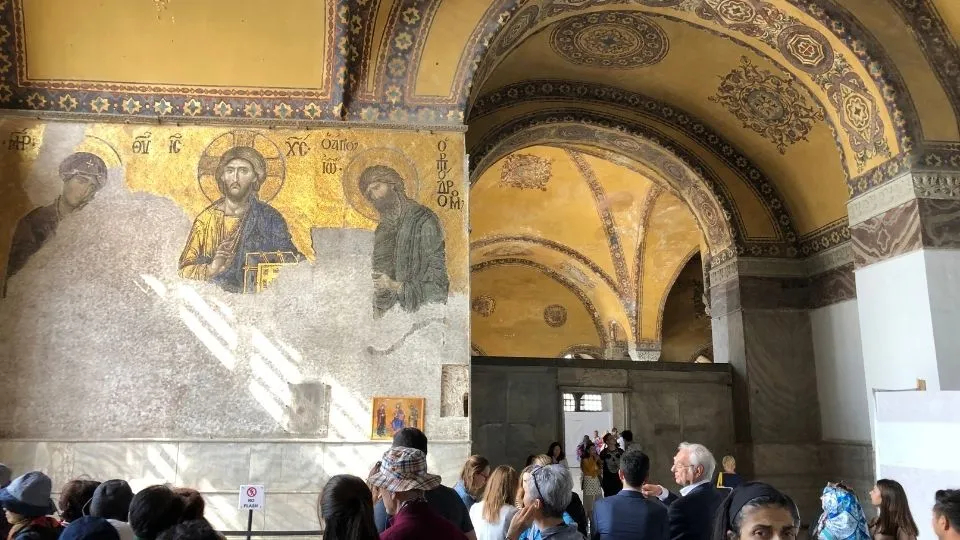
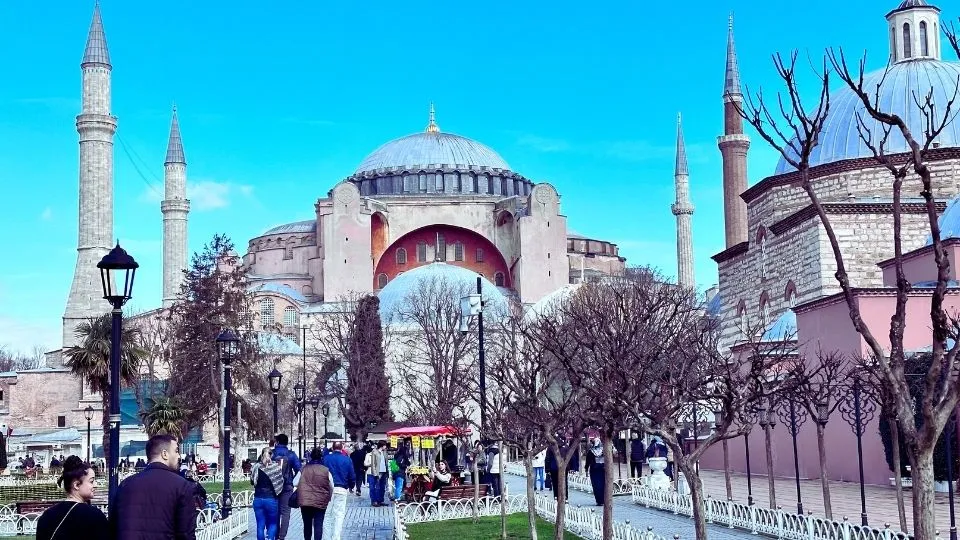
A day given to the Christian city. Hagia Sophia opens the morning: for nine centuries it held the largest dome in the Christian world, and it still keeps part of its Byzantine mosaics, among them the Deësis in the south gallery, one of the summits of Palaiologan art. Then the Roman Hippodrome, with the Egyptian obelisk, the serpent column from Delphi and the base of the obelisk of Theodosius, and the Basilica Cistern, Justinian’s reservoir held up by three hundred and thirty-six reused columns. The day closes at St Saviour in Chora, the Kariye church, by the walls: its fourteenth-century mosaics and frescoes are the most complete ensemble of late Byzantine painting still standing, with the Anastasis in the parecclesion as its centrepiece. It is a visit that asks for time and a raised neck, because the whole iconographic programme is in the vaults and domes. The four visits are a few minutes apart on foot, except Kariye, which stands by the walls and is reached by car; the guide decides the order according to the day’s queues.Notes for the day: The visiting arrangements at Hagia Sophia depend on current regulations; see the operating notes.
-
Day 3
Nicaea, the city of the councils, and Bursa
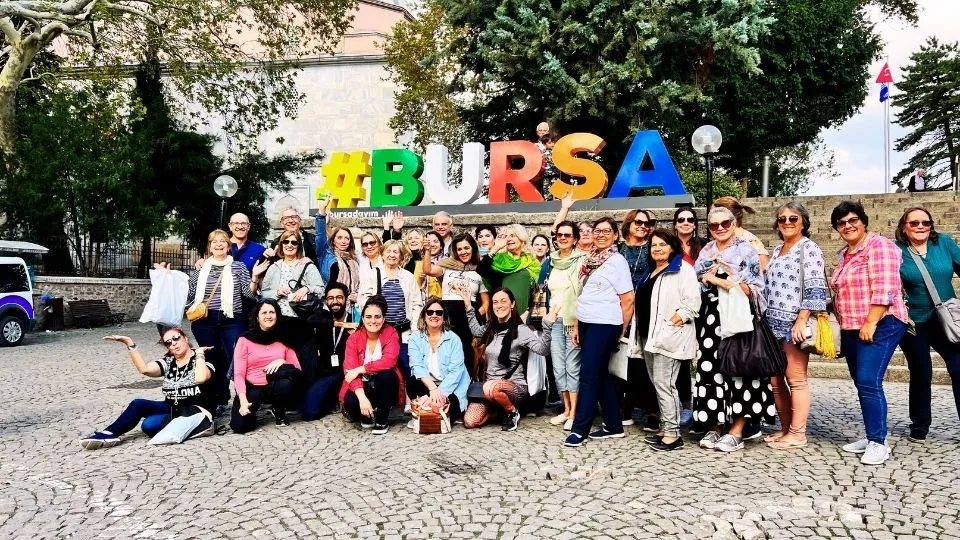
East to İznik, ancient Nicaea: here the First Council was held in 325, which produced the Nicene Creed, and the Seventh in 787, which settled the quarrel over images. The town keeps almost its whole circuit of Roman walls, with the Istanbul and Lefke gates, and at its centre the church of Hagia Sophia of Nicaea, where the council of 787 met, with remains of its floor and its frescoes. From the shore of Lake Ascanius you can see, a few metres out, the submerged basilica discovered in 2014, which appears or vanishes with the water level. Then a hundred-odd kilometres to Bursa, the first Ottoman capital, at the foot of Mount Uludağ. In all, some two hundred and eighty kilometres and four hours of driving with stops. Dinner included at the hotel. İznik also keeps its Roman street grid, so the lanes of the present-day town follow the layout of the city of the council; it is a small, quiet place, covered in two or three hours.Notes for the day: Road leg of about 280 km, approximately 4 h. The submerged basilica is seen from the shore and its visibility depends on the level of the lake.
-
Day 4
Pergamon and Smyrna: the third and second churches
Three hundred kilometres and about four hours to Pergamon, the church Revelation places «where Satan’s throne is», most likely because of the great altar of Zeus that crowned the acropolis. We visit the acropolis, with the steepest theatre in the Greek world and the terrace of the temple of Trajan; the Asclepion, a healing sanctuary that was one of the earliest hospitals of the ancient world; and the Red Basilica, the enormous Egyptian temple of Roman date that was converted into a church and which tradition identifies with the seat of that community. In the afternoon, Smyrna: the Roman Agora, with its three-aisled basilica and its cryptoportici, and the hill of Kadifekale, where tradition places the martyrdom of St Polycarp, a disciple of John and bishop of the city. The letter to Smyrna is one of the two that Revelation reproaches for nothing. Accommodation in İzmir. The acropolis of Pergamon is reached by cable car and the route up top is uneven and sloping, with about two hours of visiting between the upper city and the healing sanctuary.Notes for the day: Road leg of about 300 km, approximately 4 h. The acropolis of Pergamon has steep stretches and uneven ground.
-
Day 5
Thyatira and Sardis: the fourth and fifth churches
An inland day, one hundred and ninety kilometres and about three hours in all. First Thyatira, today Akhisar, the city of the dyers’ guilds from which came Lydia, the seller of purple whom Acts presents as the first European baptised: the site is an urban enclosure in the middle of the modern town, with remains of a basilica and a colonnaded street, and it is visited in under an hour. Then Sardis, capital of the kingdom of Lydia and city of Croesus, where the first coinage in history was struck: we visit the great temple of Artemis, the Roman gymnasium with its reconstructed marble façade, and the synagogue, the best preserved in Anatolia, with its mosaic floor and its wall of donors. The synagogue at Sardis explains the context in which those communities were born better than any text. Dinner included at the hotel in İzmir. Both of the day’s visits are short and the rest of the day is road and plateau, so there is room to spend as long at Sardis as the group wants to give it.Notes for the day: Road leg of about 190 km, approximately 3 h.
-
Day 6
Philadelphia, Laodicea and Hierapolis: the sixth and seventh churches
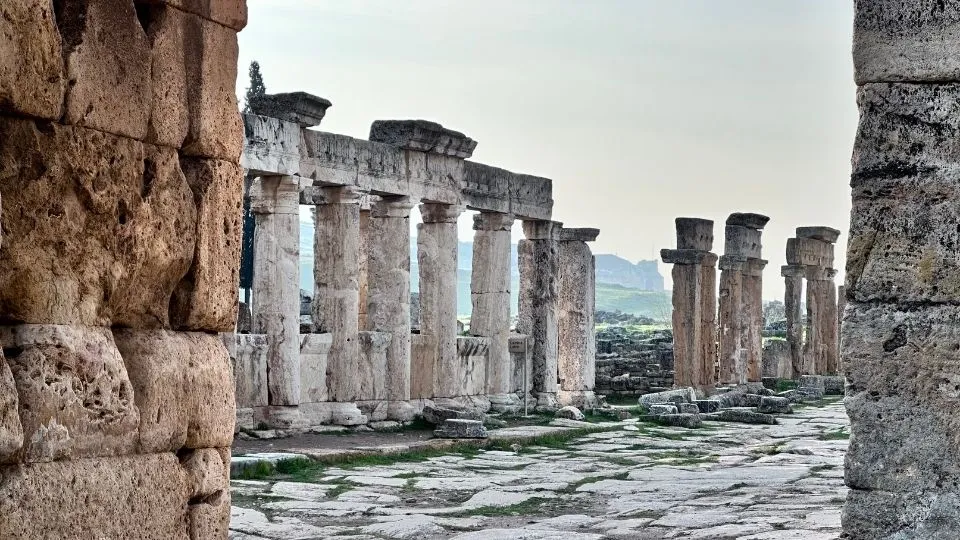
Two hundred and twenty kilometres and about three hours to close the seven churches. Philadelphia, today Alaşehir, is the church of the «open door» and the other one Revelation reproaches for nothing; of the ancient city there survive the piers and vault springings of the Byzantine basilica of St John, in the middle of the town. Laodicea, the «lukewarm» church — «neither cold nor hot» — is by contrast one of the largest and most active sites in the country: we walk the great Syria Street colonnade, the two theatres, the nymphaeum and one of the best-documented early Christian churches in Anatolia, with its baptismal font in place. The day ends at Hierapolis, beside the Pamukkale terraces, at the octagonal martyrium of St Philip on the slope above the city, and at the tomb the excavations identified as the apostle’s. Accommodation in Pamukkale and dinner included. Laodicea is the longest visit of the day, about two hours, and the most exposed: it is covered along dirt tracks between the excavated sectors, with no shade and no water inside the site.Notes for the day: Road leg of about 220 km, approximately 3 h. Laodicea is under excavation and some areas may be closed for works.
-
Day 7
Ephesus, the first church, and Miletus
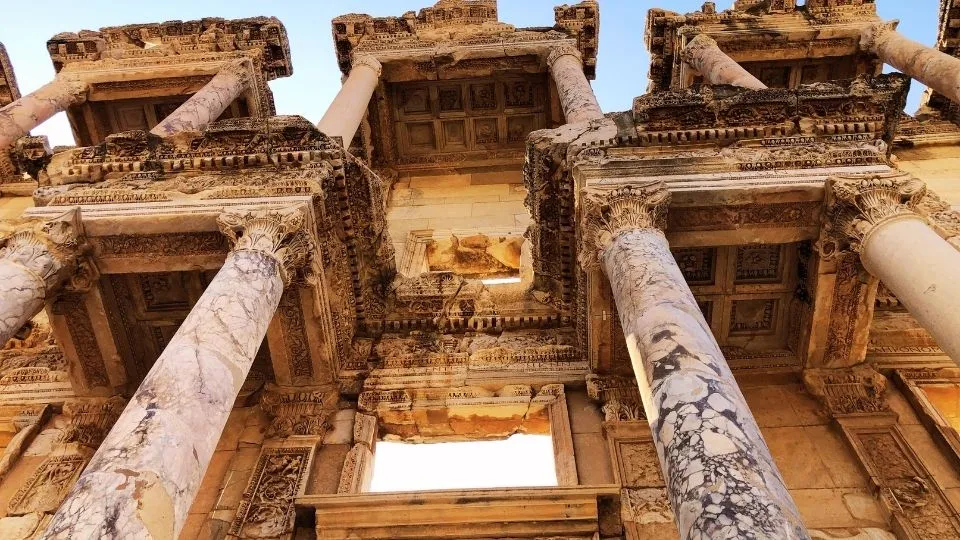
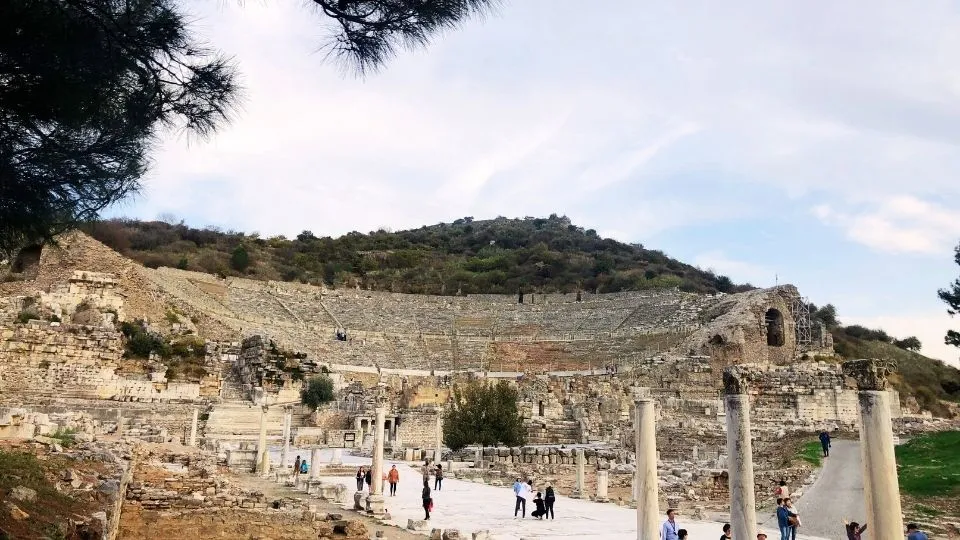
Two hundred and thirty kilometres and three and a half hours, split between the two visits. Ephesus is the first of the seven churches and the best-preserved ancient city in the eastern Mediterranean: you walk down Curetes Street to the Library of Celsus, continue along Marble Street and finish at the great theatre, the one of the silversmiths’ riot told in chapter 19 of Acts, where St Paul preached. Outside the enclosure we visit the Basilica of St John, over the tomb tradition assigns to the apostle; the House of the Virgin Mary on Mount Bülbül; and the grotto of the Seven Sleepers. In the afternoon, Miletus: the great Roman theatre, the baths of Faustina and the agora of the city where, according to chapter 20 of Acts, Paul called the elders of Ephesus to take his leave of them before going up to Jerusalem. Accommodation on the Aegean coast.Notes for the day: Road leg of about 230 km, approximately 3 h 30. The night may be in Kuşadası or in Selçuk; the confirmed hotel is stated in the quote.
-
Day 8
From the Aegean to the Mediterranean: Perge and Attalia
The longest leg of the circuit: four hundred and eighty kilometres and about six hours, with stops, from the Aegean to the Mediterranean. The destination is Antalya, the Attalia of Acts, the port from which Paul and Barnabas sailed back to Antioch at the end of their first missionary journey. Before entering the city we visit Perge, the great city of Pamphylia where Acts places the two apostles’ preaching on that same journey: the Hellenistic gate with its round towers survives, along with the stadium, the theatre, the baths and a three-hundred-metre colonnaded street with its running water channel down the middle, one of the most complete pictures left of what a provincial Roman city looked like. The visit takes an hour and a half to two hours, in the open with no shade. Accommodation in Antalya and dinner included at the hotel. The drive follows the Mediterranean coast on its last stretch and is the only day of the circuit on which the sea is in view for hours, so it works as a breather between two blocks of sites.Notes for the day: Road leg of about 480 km, approximately 6 h with stops. It is the longest transfer of the circuit.
-
Day 9
Pisidian Antioch and Iconium
Up onto the Anatolian plateau, four hundred and fifty kilometres and about six hours in all. The first stop is Pisidian Antioch, beside Yalvaç: not the Antioch of Syria, but the city in Pisidia where Paul delivered the sermon Acts records in most detail, in the city’s synagogue. Over that synagogue the basilica of St Paul was later raised, and its mosaic floor with the inscription of bishop Optimus is still in place; around it you can see the decumanus, the temple of Augustus cut into the rock and the aqueduct. Then on to Konya, the Iconium Paul visited on all three of his journeys and where, by tradition, St Thecla preached. Arrival in the afternoon, accommodation and dinner included at the hotel. The day is long on the road and short on visits, and it is designed that way: the point of it is Pisidian Antioch, which is a long way from anywhere.Notes for the day: Road leg of about 450 km, approximately 6 h with stops. Pisidian Antioch is not Antakya: they are two different and distant cities.
-
Day 10
Konya, the Ihlara Valley and Cappadocia
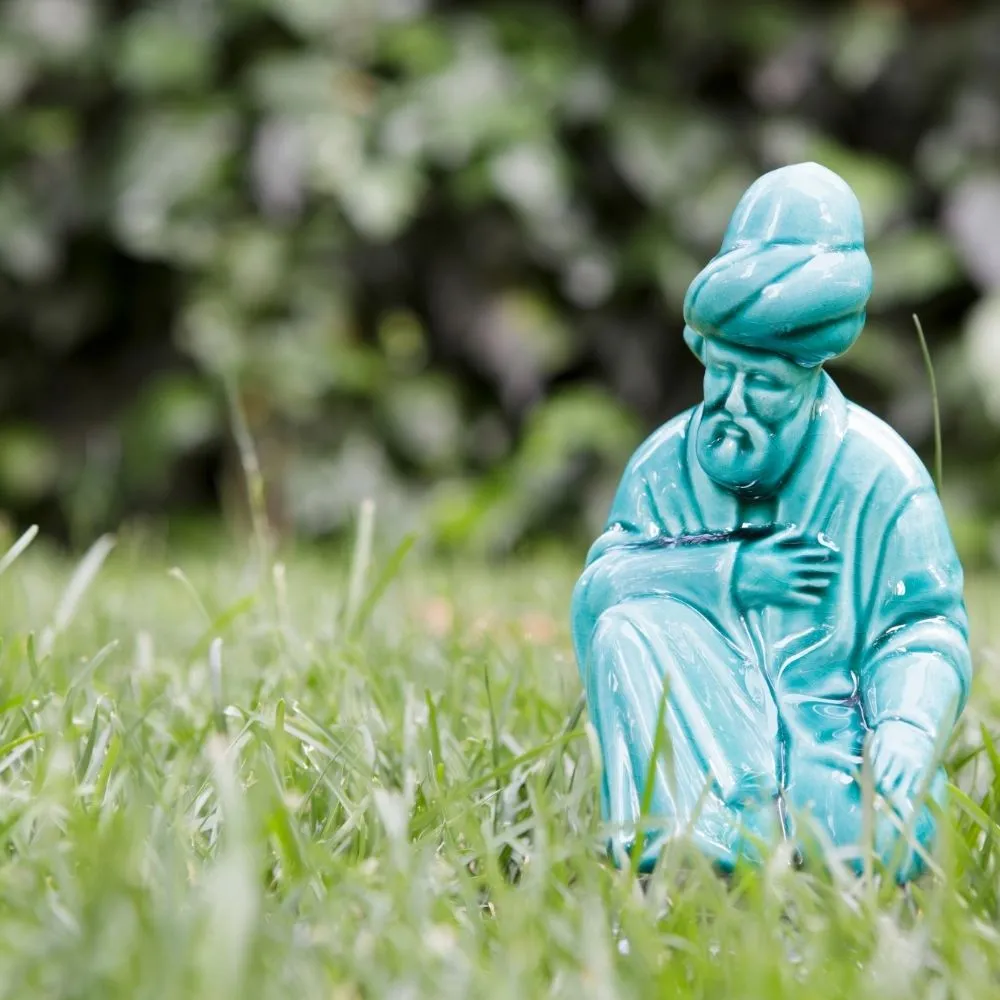
The morning begins at the Mevlana shrine, Rumi’s mausoleum under its green tiled dome, at once a tomb, a museum and a place of recollection, and the one that explains the other mysticism that has passed across this plateau. Then we set off for Cappadocia, two hundred and forty kilometres and about three hours, stopping at a Seljuk caravanserai on the silk road, with its square courtyard and carved portal. In the afternoon, a walk in the Ihlara Valley: a fourteen-kilometre canyon cut by the Melendiz river, reached by a stairway of almost four hundred steps, in whose walls there are more than sixty rock-cut churches, several with Byzantine frescoes of the ninth to eleventh centuries still legible. We walk a level stretch beside the river in the shade of the poplars, going inside two or three of the churches. Accommodation in Cappadocia. The caravanserai where we stop is one of those that punctuated the route between Konya and Kayseri, and it serves to explain how this plateau was travelled before the road we are on existed.Notes for the day: Road leg of about 240 km, approximately 3 h. The descent into the Ihlara Valley is by a long stairway; anyone who prefers not to take it can wait above with the vehicle.
-
Day 11
Christian Cappadocia and the flight to Istanbul
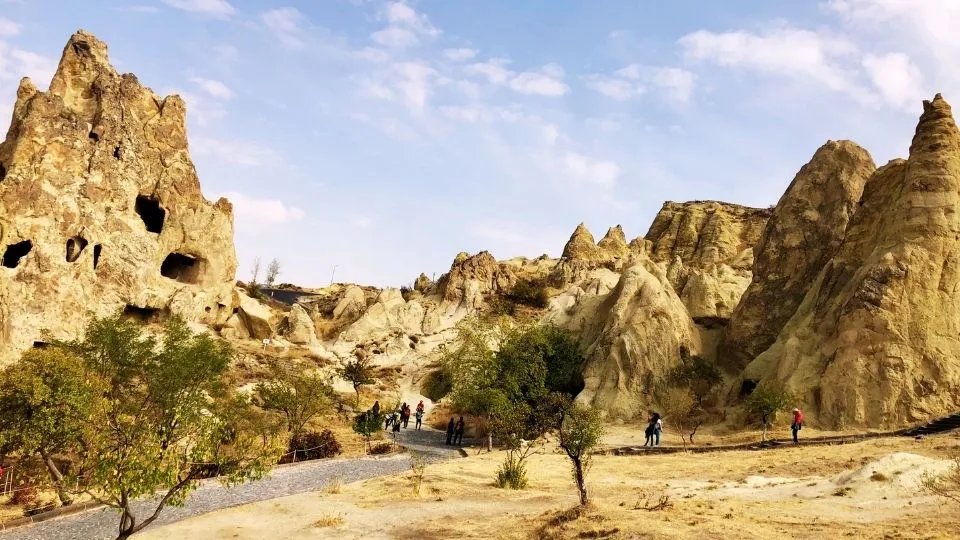
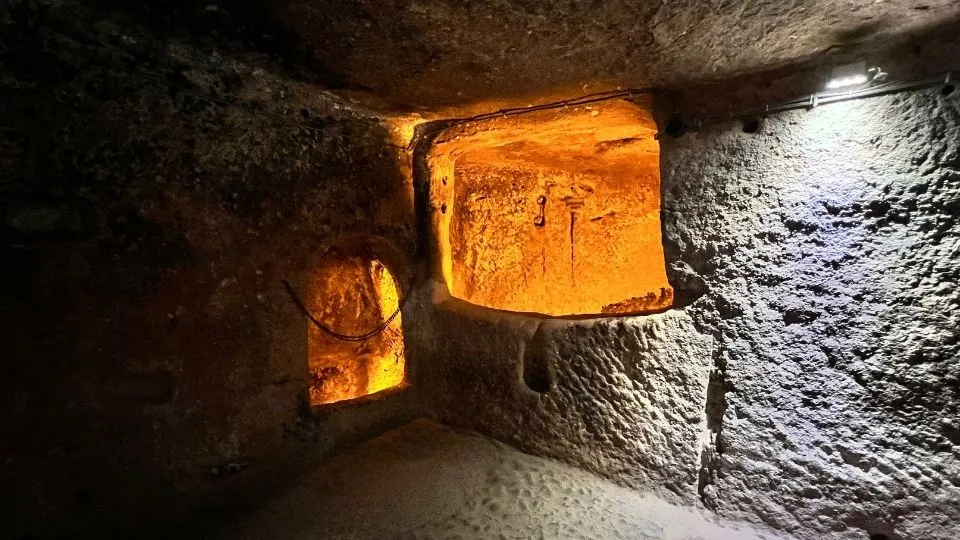
The last day of visits, given to the Cappadocia of the Christian communities. We start at the Göreme Open-Air Museum, the group of chapels, refectories and monastic cells cut into the rock, with Byzantine frescoes of the tenth and eleventh centuries: the Apple Church, St Barbara’s, the Sandal Church and the refectory with its long table carved out of the same stone. Then the basilica of St John the Baptist at Çavuşin, the oldest church in the region, hanging on a rock face reached by an iron stairway. It is completed with an underground city, one of those that sheltered those communities: narrow, low corridors, circular stone doors and ventilation shafts. In the afternoon, transfer to the airport and the flight to Istanbul, an hour and a quarter. Accommodation in Istanbul. The day’s three visits are a few kilometres apart, so the morning stretches far enough, and the afternoon leaves ample room for the airport transfer and the flight.Notes for the day: Photographing the frescoes inside the churches of the Göreme Open-Air Museum is forbidden; the Dark Church has a separate ticket and is not included.
-
Day 12
Departure
Breakfast at the hotel and free time until the transfer, whose time is worked out from the international flight and from the traffic to be expected between the hotel and the airport: in Istanbul a wide margin is advisable, because both airports are far from the centre. If the morning is free, luggage can be left at the desk after check-out. Private transfer to the airport and assistance as far as the check-in area. End of our services. If the group wants to extend the trip, the usual additions after this itinerary are one more night in Istanbul when the flight leaves in the small hours, or an extension to Antakya, the Antioch of Syria where the disciples were first called Christians; they are quoted together with the programme. If the group asks, the guide hands over the list of the biblical passages that correspond to each stage visited, which is what study groups usually want to take home.
Expected hotels
| City | Nights | Category | Hotel |
|---|---|---|---|
| Istanbul | 3 | 4* / 5* | Nippon Hotel Taksim · Elite World Hotel Taksim · Taksim Gönen Hotel · Ramada by Wyndham Hotel Taksim · Point Hotel · Ramada Grand Bazaar Laleli · Byzantium Hotel · 10 Karaköyor similar |
| İzmir | 2 | 4* | |
| Pamukkale | 1 | 4* / 5* | Richmond Thermal Hotel · Pam Thermal Hotel · Hierapark Thermal Hotel · Adem Pira Termal & Spaor similar |
| Kuşadası | 1 | 4* | |
| Antalya | 1 | 3* / 4* | Puding Hotel · 7 Inn Hotelor similar |
| Konya | 1 | 4* | Anemon Hotel Konyaor similar |
| Cappadocia | 1 | 4* / 5* | Suhan Hotel · Avrasya Hotel · Sinasos Hotel · Ramada by Wyndham Hotel Cappadocia · Crowne Plaza Cappadocia · DoubleTree by Hilton Avanos · Remus & Romulus Uçhisar · Temenni Evi · Yunak Evlerior similar |
Hotels as listed or similar; the final confirmation is given in the quotation.
How the rate is calculated
Rate tailored to the season, the hotel category and the number of travellers. Request a quotation.
Departures
Private, tailor-made
The vehicle and the guide are for your passengers only, and you choose the starting day.
The exact dates of each departure are confirmed in the quotation, together with hotel and domestic-flight availability.
Operational notes
- The order of the visits may change according to opening hours, traffic and the day’s operation. The content of the programme stays the same.
- The circuit involves eight transfers between cities, from 190 to 480 km. The two longest, on days 8 and 9, take about six hours each with stops. The whole route is by private vehicle with driver and mineral water on board.
- The seven churches of Revelation are open-air archaeological sites, some under excavation (Laodicea, Thyatira) and with areas that may be temporarily closed for works. They are visited on foot, on uneven ground and with little shade.
- The commentary is given by a licensed Spanish- or English-speaking guide holding a Ministry of Culture and Tourism licence, prepared specifically on the Pauline itinerary and the seven churches. The programme does not include spiritual assistance, religious services or the booking of places of worship; if the group travels with its own priest or pastor, say so in the request so that we can check what is possible at each stage.
- Hagia Sophia is a working mosque. Foreign visitors follow a dedicated tourist route along the upper galleries, which is suspended during the five daily prayers and, on Friday at midday, for a longer period. The visiting rules and hours depend on current regulations and may change without notice; if access is restricted on the day of the visit, the monument is explained from outside.
- To enter mosques and the Mevlana shrine, shoes must be removed and shoulders and knees covered; women must cover their hair. At the House of the Virgin Mary and in working churches the same discretion in dress is requested, with silence during services.
- The descent into the Ihlara Valley is by a stairway of almost four hundred steps, and the walk along the canyon floor is level but with stretches of loose stone. Anyone who prefers not to go down can wait above with the vehicle.
- Photographing the frescoes inside the churches of the Göreme Open-Air Museum is forbidden; the Dark Church has a separate ticket. The underground cities have narrow, low corridors that in places are walked bent over.
- The domestic flight is issued in economy class and the checked and cabin baggage allowance depends on the airline and the fare issued; the exact allowance is shown on the ticket. Schedules may be rearranged and the day’s programme follows the confirmed flight.
- Museums and sites may have a weekly closing day and different summer and winter hours. The final itinerary follows the opening calendar in force on the dates of travel.
- During the religious holidays (Ramazan Bayramı and Kurban Bayramı, whose dates move because they follow the lunar calendar) museum and shop hours change, the monuments are busier and domestic flights and roads fill up.
- A valid passport, the visa or electronic authorisation and compliance with entry requirements are the traveller’s responsibility. They should be checked in advance, as they depend on nationality.
Best time to travel
Recommended months: March, April, May, September, October, November
Gallery
Frequently asked questions
How does it differ from your 9-day Seven Churches programme?
Are all seven churches of Revelation visited?
Does the guide specialise in Christian heritage?
Can a mass or a service be held during the trip?
How much road travel is there?
When is the best time to do it?
What level of fitness does it require?
How is it requested?
Booking conditions
- Deposit
- 30% of the total when the booking is confirmed. For bookings made 30 days or less before departure, the full amount at confirmation.
- Balance
- The remaining 70%, no later than 31 days before departure.
- Payment methods
- Bank transfer or credit card. Card payments carry a 3% surcharge; charges applied by the issuing bank are borne by the client.
- Cancellations
- More than 90 days before departure: handling fee only, plus penalties on services already issued · 89–61 days: 25% · 60–31 days: 50% · 30 days or less and no-show: 100%. Reductions in places follow the same scale. Refunds within 10–14 business days of written cancellation.
Credentials
- Legal name
- Colorido Tours Turkey Turizm Ticaret Ltd. Şti.
- TÜRSAB licence
- A-12116
- Office
- Istanbul
- Operating scope
- Turkey only. Egypt, Jordan and the Greek islands only as extensions of a Turkey itinerary.
- Guides
- Licensed guides in Spanish and English
- 24/7 emergency line during the trip
- +90 544 533 53 55
- Who handles your request
- Your request is handled by our reservations team, and the same person follows the file from quotation through to operation on the ground.


